Search for life on the Lake Worth Lagoon and you find agency pages, a storage company’s cost-of-living guide and a listings site. None of them tells you what the water itself is like to live beside. This page does that from public sources only: Palm Beach County, FWC, NOAA, the Florida Department of Health and the Port of Palm Beach. It covers the shoreline, getting on the water, the water itself, the port, the wildlife you share it with and the restoration work going on around you. It does not cover prices, flood zones, insurance or permitting rules, which need advice specific to a property.
The shoreline is mostly seawall
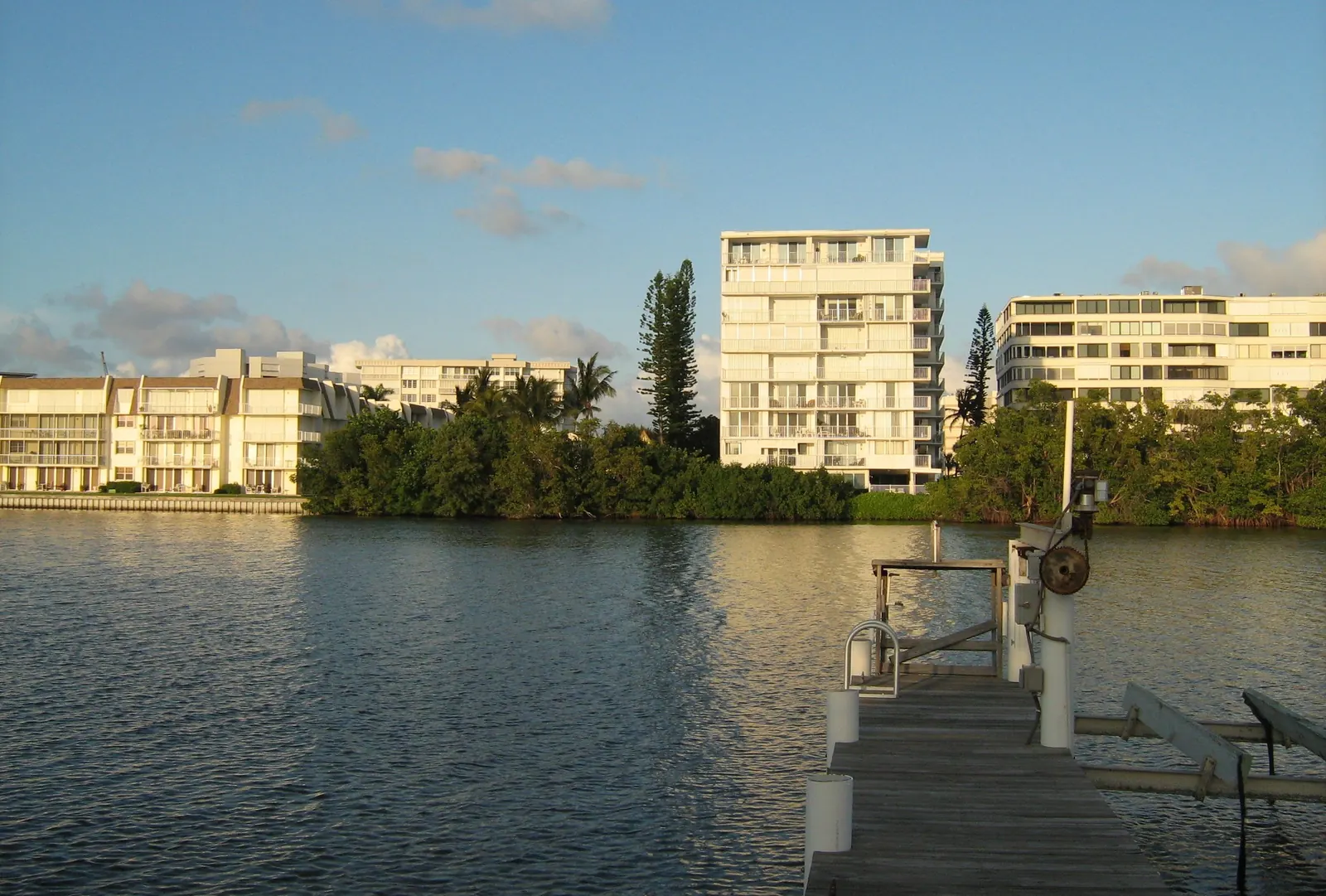
The lagoon’s edge is engineered. FWC’s Boating and Angling Guide, last updated in December 2013, says “approximately 65% of the shoreline is bulkheaded; only 19% of the shoreline remains mangrove fringed.” Palm Beach County Environmental Resources Management (ERM) says development along the lagoon replaced most of the mangroves and natural shoreline with seawalls and bulkheads. So on most of the lagoon, the water meets a wall rather than mangroves or a beach.
The county’s answer to a walled shore is the living shoreline: elevated planters set along a seawall that flood at high tide and give fiddler crabs, birds and oysters a foothold. ERM has built them at public parks in West Palm Beach, Lake Worth Beach and Lantana. They show what a seawall can carry, though the county’s projects are on public land, and we have no source on rules for private seawalls.
- The FWC guide says "Approximately 65% of the shoreline is bulkheaded; only 19% of the shoreline remains mangrove fringed." (Guide web page last updated December 2013.) FWC Boating and Angling Guide to Lake Worth Lagoon
- Palm Beach County ERM says development along the lagoon replaced most of the mangroves and natural shoreline with seawalls and bulkheads. Palm Beach County ERM: Lake Worth Lagoon
- Where seawalls line the lagoon, Palm Beach County ERM installs elevated planters that flood at high tide (living shorelines). ERM lists projects at Currie Park and Osprey Park (West Palm Beach), Bryant Park, Jewell Cove and Old Bridge Park (Lake Worth), and Bicentennial Park, Lyman Park and Lantana Nature Preserve (Lantana). Palm Beach County ERM: Lake Worth Lagoon
Getting on the water
The Atlantic Intracoastal Waterway runs the entire length of the lagoon, per FWC’s guide, so a boat anywhere on it is on the Intracoastal. The ocean is reached through two inlets. FWC’s guide gives the Lake Worth (Palm Beach) Inlet at the north end as 800 feet wide by 35 feet deep, and the South Lake Worth (Boynton) Inlet as 130 feet wide by 6 to 12 feet deep. Those are 2013 figures. The north inlet is by far the larger of the two, so where you keep a boat along the 20 miles sets how far you run to reach open water. The same guide counted eight causeways and bridges connecting the mainland to the barrier island.
For residents without a private dock, public ramps matter. Phil Foster Park in Riviera Beach has four ramps open 24 hours; Jim Barry Light Harbor Park has three; Bryant Park in Lake Worth Beach sells an annual ramp parking permit at $75 plus tax for Florida residents. West Palm Beach’s Currie Park ramps are closed until an expected spring 2027 reopening. See our boat ramps page.
The boating rules apply to residents as much as visitors. FWC says anyone born on or after Jan. 1, 1988, must have a Boating Safety Education Identification Card to operate a boat in Florida. When you approach an emergency vessel with its lights on, move over, and within 300 feet go at slow speed, minimum wake. Palm Beach County asks boaters to observe the speeds set for the Boating Safety Zones throughout the lagoon.
- Palm Beach County ERM: "the Atlantic Intracoastal Waterway cuts through the estuary". The FWC guide says the Atlantic Intracoastal Waterway "runs the entire length of the Lagoon." FWC Boating and Angling Guide to Lake Worth Lagoon (web page last updated December 2013); Palm Beach County ERM: Lake Worth Lagoon
- The FWC Boating and Angling Guide says: "The Lake Worth Inlet is 800 feet wide by 35 feet deep". (Guide web page last updated December 2013.) FWC Boating and Angling Guide to Lake Worth Lagoon
- FWC: "Anyone born on or after Jan. 1, 1988, must have a Boating Safety Education Identification Card to legally operate a boat in Florida." FWC: Boating Safety Education
- FWC: when approaching an emergency vessel with lights activated, move over; within 300 feet you must operate at slow speed, minimum wake. FWC: Boating Safety Education
The water itself
The lagoon is brackish. ERM says ocean water through the two inlets mixes with freshwater from three major flood control canals draining over 350,000 acres, and that the estuary changes daily with the tides and seasonally as the rainy season pushes more freshwater through the canals. FWC’s seagrass report attributes 51% of the freshwater inflow to the C-51 canal. ERM links a public Water Quality Dashboard from its lagoon page, and the Florida Department of Health grades marine bacteria from Good to Poor. We never call the water safe to swim; our water quality page explains how to check it.
For tides, this guide uses NOAA station 8722588, Port of Palm Beach, for predictions; its metadata lists the physical gauge as removed in 2010, so they are predictions, not live readings. Our tides page has the table.
- Per Palm Beach County ERM, ocean water flows in through 2 inlets and mixes with freshwater flowing through 3 major flood control canals that drain over 350,000 acres of land, making the water brackish. Palm Beach County ERM: Lake Worth Lagoon
- FWC's seagrass report attributes 51% of the lagoon's freshwater inflow to the C-51 canal (text reads "the freshwater inflow (51%) from the C-51"). FWC FWRI SIMM report: Lake Worth Lagoon chapter (TR-17)
- Palm Beach County ERM's Lake Worth Lagoon page links to a Water Quality Dashboard, a Funding Request page and the Management Plan. Palm Beach County ERM: Lake Worth Lagoon
- NOAA CO-OPS publishes tide predictions for station 8722588, Port of Palm Beach (26.77 N, 80.0517 W), a reference (harmonic) station. Its datum epoch is 1983-2001 and its station metadata lists the water-level gauge as removed in 2010. NOAA CO-OPS Metadata API: station 8722588
Storm season
NOAA’s National Hurricane Center says the Atlantic hurricane season runs from June 1 to November 30. We do not make flood-zone, elevation or insurance statements on this site. Those depend on the property and need the relevant agencies and your own advisers.
- NOAA National Hurricane Center: "The Atlantic hurricane season runs from June 1 to November 30." NOAA National Hurricane Center: Tropical Cyclone Climatology
A working port at the north end
The Port of Palm Beach sits at the north end of the lagoon. FWC’s guide says it created the permanent inlet by 1915. Freighters use the inlet today, and cruise traffic is set to grow: the port says a $43 million capital improvement project would address infrastructure needs at its cruise terminal and berth, and that from 2027 travelers will have more sailing options. On cargo, the port says about 80% has historically been outbound, and it expects a shift to roughly 60% exports and 40% imports by 2031.
- The Port of Palm Beach says a $43M capital improvement project would address infrastructure needs at its cruise terminal and berth, and that beginning in 2027 travelers will have more sailing options from the port. Port of Palm Beach: Official Website (news items)
- The Port of Palm Beach says about 80% of its cargo has historically been outbound, and expects a shift to roughly 60% exports and 40% imports by 2031. Port of Palm Beach: Official Website (news items)
- The FWC guide says: "By 1915, the Port of Palm Beach created a permanent inlet four feet deep at the north end of Lake Worth Lagoon. In 1925, the inlet was deepened to 16 feet and dredge spoils were deposited in Lake Worth Lagoon, resulting in the creation of Peanut Island." FWC Boating and Angling Guide to Lake Worth Lagoon

Neighbors: manatees and other wildlife
ERM says manatees are in the lagoon all year, with numbers spiking when the temperature drops, and that in cold snaps they gather at the warm-water discharge of the FPL Riviera Beach power plant, one of the most important manatee refuges on Florida’s east coast. For anyone who keeps a boat, that means manatee awareness all year. FWC says local manatee protection zones must be FWC-approved and cannot include the marked Intracoastal channel or the 100 feet beside it. We have not verified the lagoon’s zone dates or speeds, so follow the posted signs.
ERM also counts over 250 fish species and over 100 bird species, and says juvenile green sea turtles are found in large numbers in the northern lagoon. American oystercatchers have bred at restored sites for more than 20 years. More on our wildlife page.
- Palm Beach County ERM says manatees are in the lagoon all year, and when the temperature drops their numbers spike as manatees migrating along the coast find warmer water. Palm Beach County ERM: Lake Worth Lagoon
- FWC says local manatee protection zones must be approved by FWC and "cannot include waters within the main marked channel of the Florida Intracoastal Waterway or waters within 100 feet thereof." FWC: Manatee Protection Zones
- Palm Beach County ERM says juvenile green sea turtles are found in large numbers in the northern section of the lagoon. Palm Beach County ERM: Lake Worth Lagoon
Restoration happening around you
ERM says it has managed over 50 restoration projects since the late 1990s and added over 250 acres of habitat, from Munyon Island in the north to Ocean Ridge Natural Area in the south. Snook Islands in Lake Worth Beach and South Cove in West Palm Beach sit on downtown shorelines. Residents have a direct way in: the Lake Worth Lagoon Initiative’s meetings are open to the public, and ERM posts the dates on its LWLI page. The full record is on our restoration log.
- Palm Beach County ERM says that since the late 1990s it has managed over 50 large and small scale restoration projects in the lagoon, and "over 250 acres of habitat for plants and animals has been added back into the estuary." Palm Beach County ERM: Lake Worth Lagoon
- The Lake Worth Lagoon Initiative (LWLI) is described by Palm Beach County ERM as "an informal forum for stakeholders". A Steering Committee and three Working Groups (Habitat, Water, Public Outreach) meet through the year, open to the public. Palm Beach County ERM: Lake Worth Lagoon Initiative
Which town?
The lagoon’s mainland shore runs through Riviera Beach, West Palm Beach, Lake Worth Beach and Lantana, with North Palm Beach at the top and Ocean Ridge and Boynton Beach at the south inlet. Each has different public access. Our lagoon towns page covers them north to south.
Thinking of selling a lagoon home?
This guide is published by LPE Realty LLC, a licensed Florida real estate brokerage serving South Florida. If you own a home on or near the Lake Worth Lagoon and want to talk about selling, call (561) 652-6917 or visit lperealty.com. The guide stays independent of that offer: nothing on this site is a listing, and no fact here is chosen to sell a property.
Quick answers
What is a living shoreline here?
Where seawalls line the lagoon, the county installs elevated planters that flood at high tide, giving habitat to fiddler crabs, birds and oysters. Sites include Currie Park, Bryant Park and Lantana Nature Preserve.
How much of the shoreline is seawall?
FWC's guide says about 65% of the shoreline is bulkheaded and only 19% is still fringed with mangroves (2013 figures). The county says development replaced most of the natural shoreline with seawalls and bulkheads.
When is hurricane season?
NOAA's National Hurricane Center says the Atlantic hurricane season runs from June 1 to November 30.
Source: NOAA National Hurricane Center
Dates, rules and hours can change. The organisers have the final word: Palm Beach County Environmental Resources Management: Lake Worth Lagoon