
The Lake Worth Lagoon is a working urban estuary, lined with seawalls and crossed by bridges, and it still holds a lot of life. Palm Beach County Environmental Resources Management (ERM) says over 250 species of fish and over 100 species of birds use it. This page sets out what the county and FWC say lives here, the habitat that supports it, where on the lagoon you are most likely to see it, and the rules that protect it.
- Palm Beach County ERM: "Over 250 species of fish like common snook, puffer fish, and bonefish use the lagoon." Palm Beach County ERM: Lake Worth Lagoon
- Palm Beach County ERM: over 100 species of birds use the lagoon, and the American Oystercatcher, a species of special concern, "has bred at restored areas within the lagoon for more than 20 years." Palm Beach County ERM: Lake Worth Lagoon
Seagrass: the base of it all
ERM says seagrass is food for green sea turtles and manatees, and that it breaks down into the material that forms the base of the food chain. FWC’s seagrass report says seven species grow in the lagoon, and names shoalgrass (Halodule wrightii), paddlegrass (Halophila decipiens), Johnson’s seagrass (Halophila johnsonii) and turtlegrass (Thalassia) among them.
| Measure | Figure | Source and date |
|---|---|---|
| Seagrass, lagoon-wide | 1,688 acres | FWC SIMM report, 2007 |
| Seagrass, lagoon-wide | 1,592 acres (down 96 acres) | FWC SIMM report, 2013 |
| Restoration target | 2,000 acres | FWC SIMM report |
| Share in the northern lagoon, near Singer Island | 65% | FWC SIMM report |
| Share in the central segment | 12% | FWC SIMM report |
| Share in the southern segment | 23% | FWC SIMM report |
Two cautions. The acreage figures stop in 2013, and we found no newer lagoon-wide number in a source we could check, so we make no claim about the trend since. And a secondary news source has attributed the same acreages to the south lagoon only; we follow FWC’s report, which gives them for the whole lagoon.
- FWC's seagrass report says seven species of seagrass are found in the lagoon, naming among them shoalgrass (Halodule wrightii), paddlegrass (Halophila decipiens), Johnson's seagrass (Halophila johnsonii) and turtlegrass (Thalassia). FWC FWRI SIMM report: Lake Worth Lagoon chapter (TR-17)
- FWC's seagrass report says seagrass in Lake Worth Lagoon was estimated at 1,592 acres in 2013, a small decrease (96 acres) from 1,688 acres in 2007. FWC FWRI SIMM report: Lake Worth Lagoon chapter (TR-17)
- FWC's seagrass report says most of the seagrass (65%) is in the northern lagoon near Singer Island, 12% in the central segment and 23% in the southern segment. FWC FWRI SIMM report: Lake Worth Lagoon chapter (TR-17)
- Palm Beach County ERM says seagrass is food for green sea turtles and manatees and breaks down into matter that forms the base of the food chain. Palm Beach County ERM: Lake Worth Lagoon
Manatees
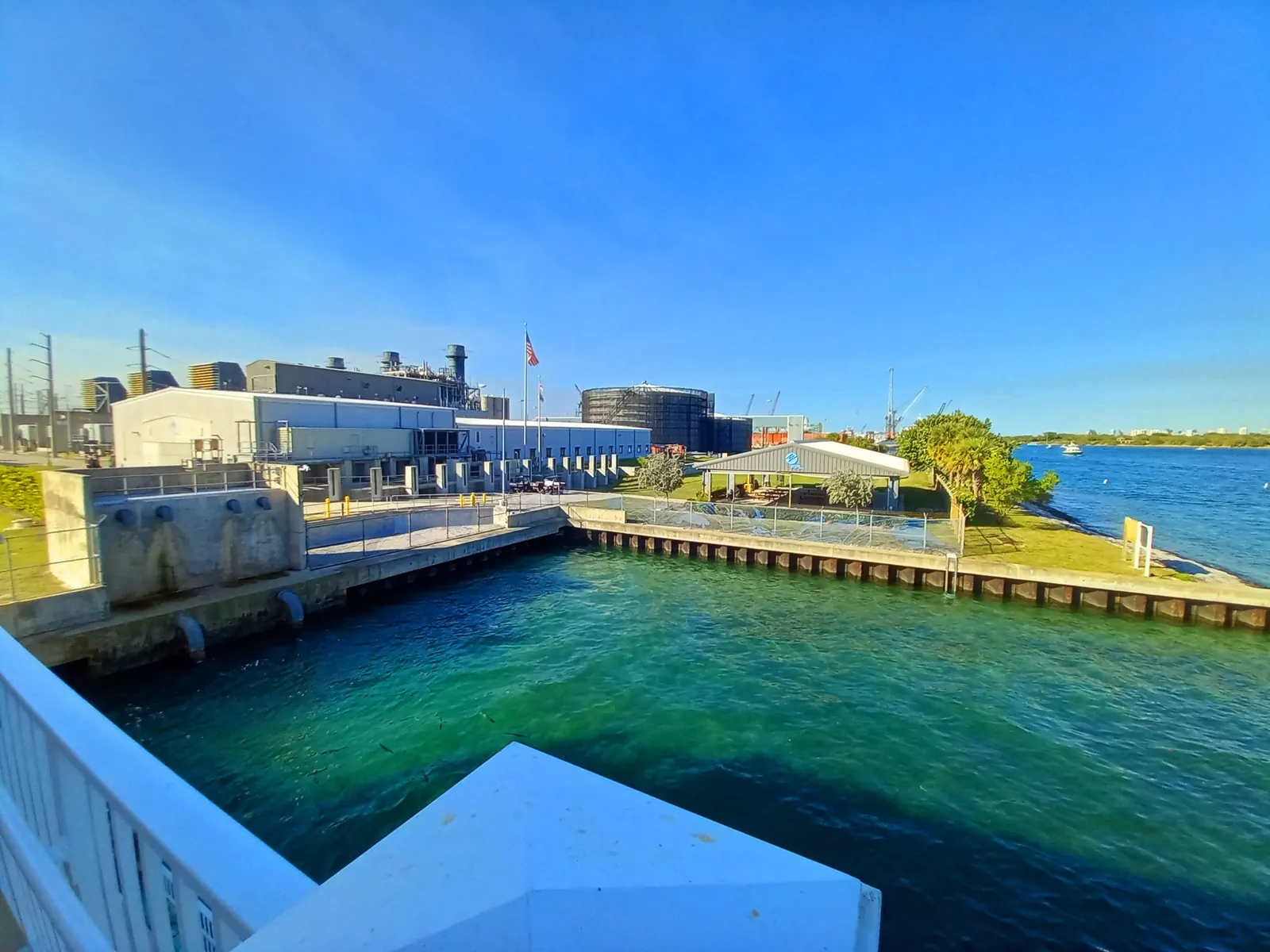
ERM says manatees are in the lagoon all year, and that their numbers spike when the temperature drops, as manatees migrating along the coast look for warmer water. In cold snaps they gather in the warm water near the FPL Riviera Beach power plant discharge, which ERM calls one of the most important manatee refuges on Florida’s east coast. FPL runs Manatee Lagoon, a free education center beside it, open daily during manatee season from November 15 to March 31 and closed on Mondays from April 1 to November 14. The center’s listed hours are 9 a.m. to 4 p.m.
Manatee Lagoon has no water access. Fishing, swimming, pets (other than ADA service animals), drones and feeding wildlife are all prohibited. More on the center and the season is on our manatees page.
- Palm Beach County ERM says manatees are in the lagoon all year, and when the temperature drops their numbers spike as manatees migrating along the coast find warmer water. Palm Beach County ERM: Lake Worth Lagoon
- Palm Beach County ERM says that in cold snaps manatees congregate in the warm water near the FPL Riviera Beach Power Plant discharge, "recognized as one of the most important water manatee refuges on the east coast of Florida", and points visitors to the Manatee Lagoon education facility there. Palm Beach County ERM: Manatees
- Manatee Lagoon: "Closed on Mondays from April 1 – November 14. Open daily during manatee season, November 15 – March 31." Manatee Lagoon – An FPL Eco-Discovery Center
Manatees and boats
Palm Beach County Parks asks boaters, for public safety and to protect manatees, to observe the operating speeds set for the Boating Safety Zones throughout the lagoon. FWC says local manatee protection zones must be approved by FWC and cannot include waters within the main marked channel of the Florida Intracoastal Waterway or within 100 feet of it. We have not verified the exact zone boundaries, speeds or seasonal dates for the lagoon, so we do not list them. Read the posted signs and FWC’s Palm Beach County zone maps before you go.
- Palm Beach County Parks asks boaters, for public safety and to protect manatees, "to observe the operating speeds established for the Boating Safety Zones located throughout the Lake Worth Lagoon", and vessels may not be operated through any designated swimming area. Palm Beach County Parks & Recreation: Phil Foster Memorial Park
- FWC says local manatee protection zones must be approved by FWC and "cannot include waters within the main marked channel of the Florida Intracoastal Waterway or waters within 100 feet thereof." FWC: Manatee Protection Zones
Sea turtles
ERM says juvenile green sea turtles are found in large numbers in the northern section of the lagoon. That fits the seagrass map: green turtles eat seagrass, and 65% of the lagoon’s seagrass is in the north near Singer Island. ERM also lists green sea turtles among the wildlife at Snook Islands Natural Area in the south and South Cove in West Palm Beach.
- Palm Beach County ERM says juvenile green sea turtles are found in large numbers in the northern section of the lagoon. Palm Beach County ERM: Lake Worth Lagoon
Fish
ERM’s figure is over 250 species of fish, naming common snook, puffer fish and bonefish as examples. The Blue Heron Bridge area at Phil Foster Park is, in the county’s words, “internationally recognized” for marine life; its snorkel trail of limestone boulders and reef modules covers two acres in 6 to 10 feet of water. Harvesting or possessing tropical fish or tropical ornamental marine plants is prohibited in the park and its waters, and knives and spear guns may not be used to take fish in county park waters.
Snook have their own rules. Palm Beach County is in FWC’s Southeast snook region, closed December 15 to January 31 and June 1 to August 31, with a slot of 28 to 32 inches total length and a snook permit required on top of a fishing license. Details are on our fishing page.
- Palm Beach County: the Blue Heron Bridge area is "internationally recognized" for marine life. A snorkel trail of limestone boulders and prefabricated reef modules spans a two-acre area in 6 to 10 feet of water, built with 600 tons of rock. Palm Beach County Parks & Recreation: Phil Foster Memorial Park
- Palm Beach County: harvesting or possessing tropical fish or tropical ornamental marine plants is prohibited within Phil Foster Memorial Park and its waters (Rule 68B-42, F.A.C.), and knives or spear guns may not be used to capture fish in county park waters. Palm Beach County Parks & Recreation: Phil Foster Memorial Park
- FWC lists, for the region covering Palm Beach County: "Closed Season: December 15 – January 31, and June 1 – August 31" and "Slot Limit: Not less than 28" or more than 32" total length". FWC: Snook recreational regulations
Birds
ERM counts over 100 bird species using the lagoon. It singles out the American oystercatcher, a species of special concern, which “has bred at restored areas within the lagoon for more than 20 years.” The county lists oystercatchers at Snook Islands and wading birds at South Cove, and its living shoreline planters on seawalls are designed to give birds, fiddler crabs and oysters habitat on a hard edge.
- Palm Beach County ERM: over 100 species of birds use the lagoon, and the American Oystercatcher, a species of special concern, "has bred at restored areas within the lagoon for more than 20 years." Palm Beach County ERM: Lake Worth Lagoon
Oysters and mangroves
Oysters are filter feeders that ERM says remove algae, microorganisms, pollutants and particulates and can improve water quality. Restored Johns Island has a 14-acre oyster bar near the C-51 Canal, and the Snook Islands and South Cove projects added oyster reef too. Mangroves are scarcer than they once were: FWC’s 2013 guide says only 19% of the shoreline remains mangrove fringed. ERM’s projects at Munyon Island, Peanut Island, Snook Islands and South Cove all added mangrove habitat.
- Palm Beach County ERM says oysters are filter feeders that remove algae, microorganisms, pollutants and particulates and can improve water quality. Palm Beach County ERM: Lake Worth Lagoon
- The FWC guide says "Approximately 65% of the shoreline is bulkheaded; only 19% of the shoreline remains mangrove fringed." (Guide web page last updated December 2013.) FWC Boating and Angling Guide to Lake Worth Lagoon
Where to see wildlife from public land
| Place | What the operator lists | Access |
|---|---|---|
| Manatee Lagoon, West Palm Beach | Manatees at the FPL warm-water outflow, especially in cold snaps | Free; 9 a.m. to 4 p.m.; open daily Nov. 15 to March 31 |
| Snook Islands Natural Area, Lake Worth Beach | American oystercatcher, common snook, green sea turtle, West Indian manatee | Boardwalk and kayak launch; three parking spots, more at Bryant Park |
| South Cove Natural Area, West Palm Beach | Fisheries, wading birds, manatees, sea turtles | 556-foot boardwalk; sunrise to sunset |
| Phil Foster Park, Riviera Beach | Marine life on the snorkel trail by the Blue Heron Bridge | Diving sunrise to sunset outside the guarded area |
| Munyon Island | Restored mangroves, salt marsh, hammock and seagrass | By kayak, per ERM |
Upcoming wildlife dates
Manatee Lagoon manatee season: open daily
Organiser date for 2026Manatee Lagoon says it is open daily during manatee season, November 15 to March 31, and closed on Mondays from April 1 to November 14.
Recurring annual window stated on the Manatee Lagoon site.
Add to calendar: Google Apple / Outlook (.ics)
Source: Manatee Lagoon – An FPL Eco-Discovery Center, checked 2026-10-20
Manatee Lagoon Migration Celebration
Undated; do not show a date.Manatee Lagoon describes a free, family-friendly Migration Celebration welcoming manatees back to warmer waters. No date was visible on the page.
Free Source: Manatee Lagoon: Events, checked 2026-10-20
ManateeFest (Manatee Lagoon anniversary celebration)
Undated; do not show a date.Manatee Lagoon calls ManateeFest its annual anniversary celebration, with exhibitors and a kids fun zone, focused on manatees and the Lake Worth Lagoon. No date was visible on the page.
Source: Manatee Lagoon: Events, checked 2026-10-20
Quick answers
When can I see manatees?
Manatees are in the lagoon all year, the county says, but numbers spike when the temperature drops. In cold snaps they gather in the warm water near the FPL Riviera Beach power plant, which the county calls one of the most important manatee refuges on Florida's east coast.
Source: Palm Beach County ERM: Manatees
When is Manatee Lagoon open?
Manatee Lagoon, An FPL Eco-Discovery Center, says it is open daily during manatee season, November 15 to March 31, and closed on Mondays from April 1 to November 14.
Are there manatee speed zones in the lagoon?
Yes. Palm Beach County Parks asks boaters to observe the speeds set for the Boating Safety Zones throughout the Lake Worth Lagoon, for public safety and to protect manatees. Check the posted signs and FWC's Palm Beach County zone maps for exact limits and dates before you go.
Source: Palm Beach County Parks & Recreation: Phil Foster Memorial Park
Dates, rules and hours can change. The organisers have the final word: Palm Beach County Environmental Resources Management: Lake Worth Lagoon